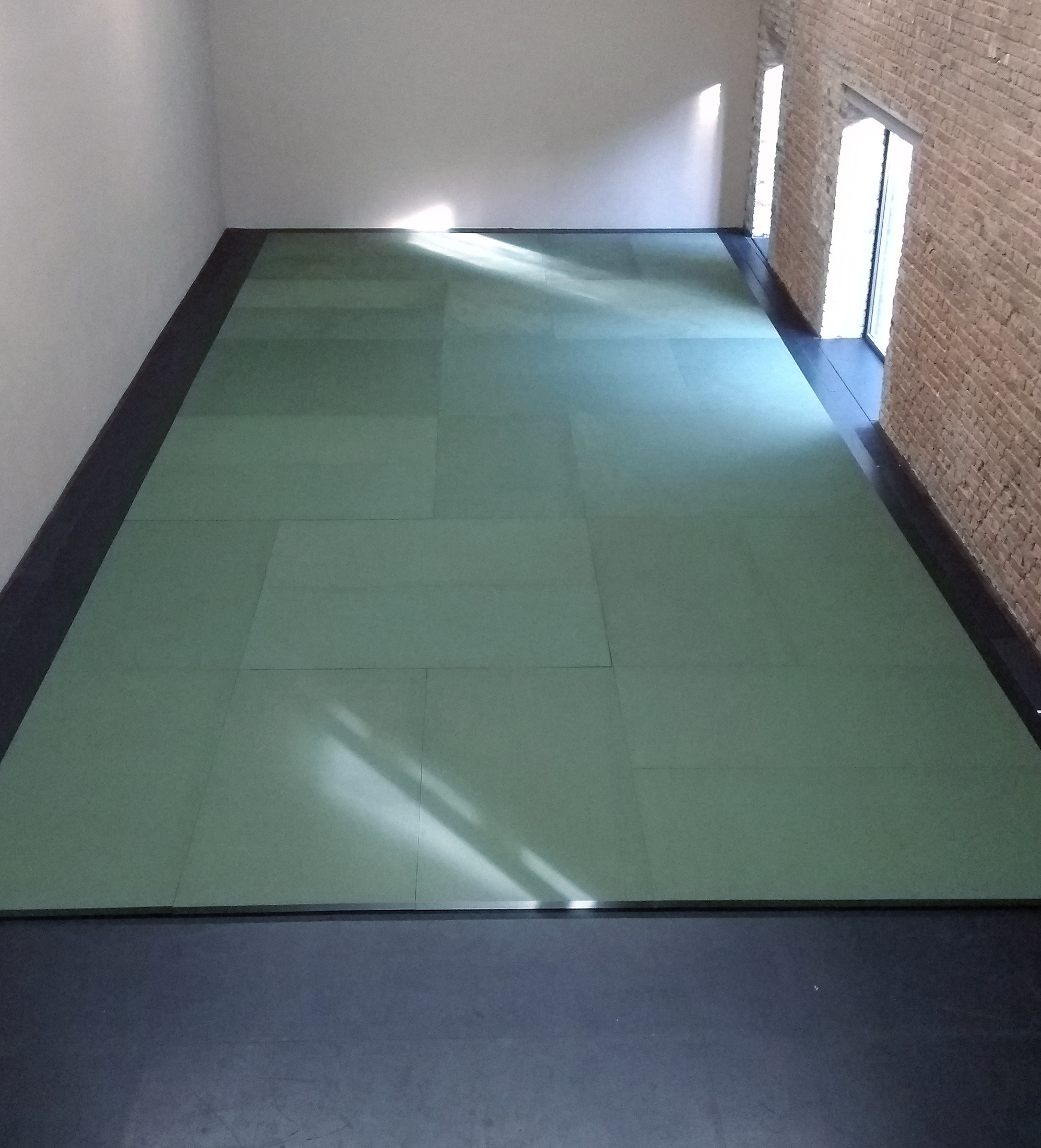
The Mobile Ensemble is a group of Berlin-based dance artists and choreographers gathered around Isabelle Schad and her artistic practice. For about ten years, they have been coming together at regular intervals for her Open Practice Sessions at Tanzhalle Wiesenburg[1] and are continuously or occasionally involved in her choreographies.
As the name suggests, the Mobile Ensemble is not a fixed group that works together continuously, but rather a dynamic constellation that shifts in shape and composition depending on several factors (in a not-so-random order): the funding available, people’s schedules and availability, and the scale of the project at hand.
For many, the way they came to know Isabelle—and began working with her—was through the Open Practice Sessions at the Tanzhalle Wiesenburg. Many first joined these shared training sessions, and then the alchemy did the rest.
In 2024, the Mobile Ensemble applied for—and was awarded—the Tanzpraxis grant from the Berlin Senate, marking a new phase in the life of the ensemble.
In this written conversation with some members of the Mobile Ensemble, we explore the working methodologies, values, and challenges that shape this unique constellation.
Let’s jump back in time. Do you remember the first Open Practice Session you attended? What memories, images, or movements have stayed with you the most?
Johanna Ackva: Yes, I do! I think the most remarkable memory is not that of a specific movement, constellation or shape, but a memory of atmosphere and sensation, which in their very nature are difficult to describe. But I try: There was something very calm in this practicing together – although you have to imagine a full space of people moving/dancing in a way that does definitely get you to sweat. This calmness and sense of peace was really attractive and stuck with me.
Maja Zimmerlin: The grounded and calm energy is also my prevailing memory together with the sensation of trust in the group and of familiar feelings in the middle of a lot of unfamiliar movements and practises. From the very first moment I felt a wide open heart and a calling to dive into this.
Lea Pischke: I can second Johanna and Maja. The first time I attended an Open Practice Session, the sense of focus and quietness filled the space. It wasn’t a “holy silence,” as one might assume; it was simply quiet. People were working. I was rather intimidated because I could sense that there was already a shared knowledge amongst the practitioners that I didn’t have yet. Added to that, I wasn’t yet very accustomed to standing on a tatami mat. I remember the squishy sensation underneath the soles of my feet, and my constant staring at people’s pelvises in order to fathom how this peculiar weight shift and energy travelling pans out in people’s bodies. I’m still on it.
David Kummer: Listening to you speak about the calm and welcoming atmosphere, I realise that arriving at Wiesenburg[2] is already a grounding experience in itself. It feels like entering a safe universe for creation, research, and being. Tea and conversation are part of the arrival, taking time to land together before the practice. I took several Open Practice Sessions over the years: some sessions took place indoors, others outside at Humboldthain park[3] with swords under the trees. I remember the large trees and the soothing, detailed quality of the practice. It felt like working with oneself while always remaining connected to the others.
Yen Lee: I remember the image of swords being picked up from the floor in front of each body as we stood in a circle of five or six. The whole event was simple and naturally unfolding, as if nothing required any extra effort…Then we left the practice for whatever came next; some biked away with the swords attached to their bikes or tucked into their backpacks.
Melika Akbariasl: I can recall a ‘’U’’ form of people standing on obvious-stable-well built common ground for strengthening the UNION.
Calm, dynamic, vibrant quality in space; in people…!
Viviana Defazio: For me, it is a sense of playfulness that stayed above all, and the opportunity to relate in different ways with so many different bodies, people, and energies—each encounter becoming a new journey.
Manuel Lindner: My first encounter with Isabelle’s practice was not through the Open Practice Sessions, but during my dance studies. At the time, two choreographers were invited to teach us one of their repertoire pieces, and one of them was Isabelle with Der Bau[4]. We began with the rehearsal of the other piece, which was full of drama over who was chosen for the special parts. From that experience, we then dived into Isabelle’s practice, where hierarchy played no role. I remember doing all the Qi Gong and Body–Mind Centering/embryology exercises, everyone together yet following their own individual breath and rhythm. I also remember all the polyphonic movement patterns that emerged in the space.
Which aspects of Isabelle’s practice motivated you to start—and continue—working with her?
Manuel Lindner: Since I saw Isabelle doing her Unturtled[5] piece with the big shirt, I was caught. I didn’t know what the practice was, but I was intrigued by how precise the movement was and still so free. And it is still one of the funniest dances I ever saw. I guess what made me stick to it is the practice of negotiations between form and individual flow, between inside and outside, between collective and individual, just to mention a few.
Jan Lorys: I remember seeing Pieces and Elements[6]. It felt like watching a sunset; I wanted to experience it from the other side, as a performer rather than a spectator. This required a great deal of calming down on my part, and Isabelle, together with the group I met at Wiesenburg, provided invaluable guidance in that process. That sense of support and being part of a community is especially meaningful to me nowadays, when the financial situation for freelancers in Berlin is so precarious. Through this feeling of belonging, I can hold on to the part of my identity that knows I am a dancer, even in the absence of work.
Lea Pischke: Yes, the group aspect is also very precious to me. When you dance, you can actually get bored of your own body’s dancing habits. But when you engage with another dancer’s body, a whole world opens up. You understand your own body through the other body, because you understand that your body is like theirs, and yet—you are entirely different. This particular paradox of similarity and difference makes working with others so exciting.
Maja Zimmerlin: The group energy that Isabelle creates at Wiesenburg also plays a very important role for me, but I will not repeat too much about it. I personally very much appreciate the consistency that Isabelle brings into the work. The daily Aikido practice, and the ancient wisdom of this practice that we consequently practice and come back to with every single step and weight shift. This consistency gives such a strong anchor and foundation. She gives the time that needs to be dedicated to this, and it resonates—in the artistic work, in the visual coherence, in the way the space is being used, etc. And then the play between the detail and the global forces too…
Yen Lee: I also appreciate sensing how certain principles gradually become self-evident through practice, and observing how they operate on multiple levels, including the physical, social, and philosophical. This process fosters a genuine sense of self-organization, both within one’s own body and in the way we work together as a group. Alongside this comes an awareness of multiple, sometimes contrasting, points of focus, and the ability to navigate between them. I also value the fact that both the individual and the collective are acknowledged, respected, and celebrated at the same time, even though they often function in very different ways.
Each of you, alongside your work with Isabelle and the Mobile Ensemble, has your own personal artistic practice. How do you experience this interconnection?
Viviana Defazio: As a shiatsu practitioner, I strongly relate to Isabelle’s practice, as both shiatsu and her approach are grounded in the idea that connection with oneself is the basis for meaningful connection with others.
Manuel Lindner: I always do little interweavings for myself with sub-scores from my own practice within the work with Isabelle. I feel it helps us both. Recently, I started to work on a piece together with colleagues I have known for many years through Isabelle’s practice. It’s interesting to have a common reference point to go along with and against.
Melika Akbariasl: I can state it as: I am having a clear meeting point every now and then through a specific role (e.g. as the costume stylist or once also as a solo choreographer-dancer). I enjoy coming from a non movement side in contact-projects and I am endlessly appreciative of being given the chance to appear with my skills/experiences, to connect with the whole through the given task and to concentrate on expanding in many ways/senses as A GROUP and as one.
Lea Pischke: As a freelancer in dance, I—and I assume many others—often experience what I like to call “intellectual cross-pollination.” While working on my own work or on projects with various other colleagues, I find myself wondering about my connection to the ground and how my kinetic energy travels through my body (“in den Boden ableiten,” as Isabelle would put it). Another aspect that entered my own practice is the aspect of being precise without being accurate, which I find particularly appealing. By this, I mean the full incorporation of a principle in your own, individual, unique body.
David Kummer: I could say that my exchange with Isabelle began through shiatsu, and later expanded into choreography. This intersection between shiatsu and choreography is deeply aligned with my practice. Now, after three years of working continuously with her, I realise more and more interconnections. The body and mind grow with experience and knowledge, and these connections become deeper and richer—the body maybe wiser. On the somatic level, I feel my focus has changed, and my eyes love the infinity of space, equivalent to the length of the space of Wiesenburg. Also, the trust in a non-verbal approach and in interweaving energetic work with choreographic scores has become more versatile.
Maja Zimmerlin: I was first attracted to Isabelle’s work after reading a newsletter announcing one of her pieces. What she wrote resonated strongly with me, so I went to see the piece and read the catalogue that was available. In both her art and her writing, she found words for something I was already living and searching for. I don’t think I would have become part of the Mobile Ensemble without this resonance between her artistic vision and my own as an artist.
Thanks to the Tanzpraxis grant, you now have a small budget to keep the ensemble active. Could you describe what kinds of activities you have been—and are currently—engaged in, and how you structure the work?
Johanna Ackva: Together with Jan Lorys, I initiated a weekend of sharing practices and work, in April this year. We gave it the title TO GÆTHER. I really enjoyed those days and sessions, to which we also invited dancers and movers from outside the ensemble.
Maja Zimmerlin: The Tanzpraxis grant has further allowed us to get more conscious about us as an ensemble. Has made us more active as a small community, that can organise itself and care for each other and activities. I would say before the Tanzpraxis grant, we were more passively following. The sense of “togetherness” has evolved.
Manuel Lindner: It’s amazing to have a scholarship to link times between productions, to nourish the connection between each other both in continuing Isabelle’s practice as well as having space to follow individual practices. It decentralises the ensemble from Isabelle’s initiatives to more diverse ways of togetherness. For me the big question stays how to manage who is part of an ensemble that is so mobile. The possibility of the funding brought together a part of the group but also made other parts of the mobile collective move away as they have not been included in the funding. In the way we use the funding we achieve a mobilisation of the structures of togetherness but at the same time the group is more enclosed.
Lea Pischke: We were able also to pay an external practitioner – the shihan 8th dan master Gerhard Walter – to teach us in the frame of an intensive workshop. The grant also gives us the time and space to practise our newly acquired knowledge in an individual or smaller group setting or experiment with the knowledge and fuse it with our own practice. Lastly, it gives us the opportunity to share our own practice with the other members of the group, i.e. Johanna’s and Jan’s TO GÆTHER sessions.
David Kummer: The ensemble budget mainly supports practical organisation—sharing space, key exchanges, cleaning, and communication. Using the space alongside other colleagues has been a pleasure, fostering mutual support while working on different projects, both indoors and outdoors at Wiesenburg. Maintaining this structure allows for personal work, rest, research, or simply sensing the collective. It also offers the chance to care for the garden of the Wiesenburg and its plants, making the space feel more holistic.
Would you say there are specific principles, values, or an ethical approach that guide the way you work together as an ensemble?
Manuel Lindner: For me it’s a quality of finding out on the way. Before the Tanzpraxis funding most encounters have been initiated and guided by Isabelle. It shifted into something where different people take initiatives, on different levels in terms of practice, social gatherings as well as managing communication and bureaucratic necessities. It is a very loose structure where a lot of things could and do happen. There is a great deal of trust, listening and following various proposals. From my point of view the group functions so far on very similar principles than the group negotiations within Isabelle’s latest works, those of constant change between who is protagonist and group. It’s an inspiring way of being together, it would be great to reflect at some point how it works for everyone. It might be that some of us end up with responsibilities they don’t want and I’m wondering if the space is equally safe for everyone to propose an initiative.
Lea Pischke: We all try to make sure that everyone is being heard and listened to in conversation and discussion. Concerns are taken seriously, and so are suggestions within the group. We do care for each other and we do care for the space we practise in. It might be silly to mention this here, but when I enter Tanzhalle Wiesenburg to work on my own practice and I notice that the kitchen area is clean, that someone has taken the bins out, that the toilet is in a good state, that the mats have been vacuumed, well, it makes me feel good and taken care of. And it inspires me to do the same for the one who’ll have their rehearsal or practice session after mine.
We’re now in the middle of the Tanzpraxis Stipendium.
What kind of balance do you feel you need to strike at this stage of the process?
Lea Pischke: The Tanzpraxis grant allows me to feel the belonging to a collective from its positive side: I get together with people, I concentrate on what I do together with the others, and once we part, I don’t have to immediately throw myself at the job market for the next hustle, because I have just been paid for my practice. That takes a lot of stress off me and makes my practice more profound. I can fully concentrate on the practice without having this constant nag at the back of my head “you need to earn money once this is finished, you need to write applications, ring theatres, speak with people, network, explain, budget”. It does improve the quality of my practice within the group significantly.
Maja Zimmerlin: I suppose the Tanzpraxis grant brings—or has brought—awareness of the resources needed to sustain a certain level of regularity and safety for a larger group like ours.
Thanks to Johanna Ackva for helping with the revision of the text.
[1]Tanzhalle Wiesenburg is an independent space for contemporary dance and performing arts in Berlin-Wedding, founded in 2012 by Isabelle Schad, Bruno Pocheron, Heiko Schramm, Florian Bach, Susanne Beyer, Sybille Müller, Mehdi Toutain Lopez. It is located located within the historic Die Wiesenburg site — a former homeless shelter now repurposed as a cultural and creative areal. (https://tanzhallewiesenburg.net)
[2] The Open Practice Sessions usually take place in the Tanzhalle Wiesenburg, an artist-run cultural and rehearsal space in the Wiesenburg complex in the Wedding district of Berlin. It functions as a place for artistic creation, research, and interdisciplinary collaboration with a focus on dance and performing arts. (https://tanzhallewiesenburg.net/de/start/)
[3] For texts on the open-air Open Practice Sessions at Humboldthain during the pandemic, see the texts on this website: “New Openings” and “Mutating Practice”.
[4] Der Bau was created in 2014.
[5] Unturtled was created together with Laurent Goldring in four different versions between 2009 and 2011.
[6] Pieces and Elements was created in 2016.
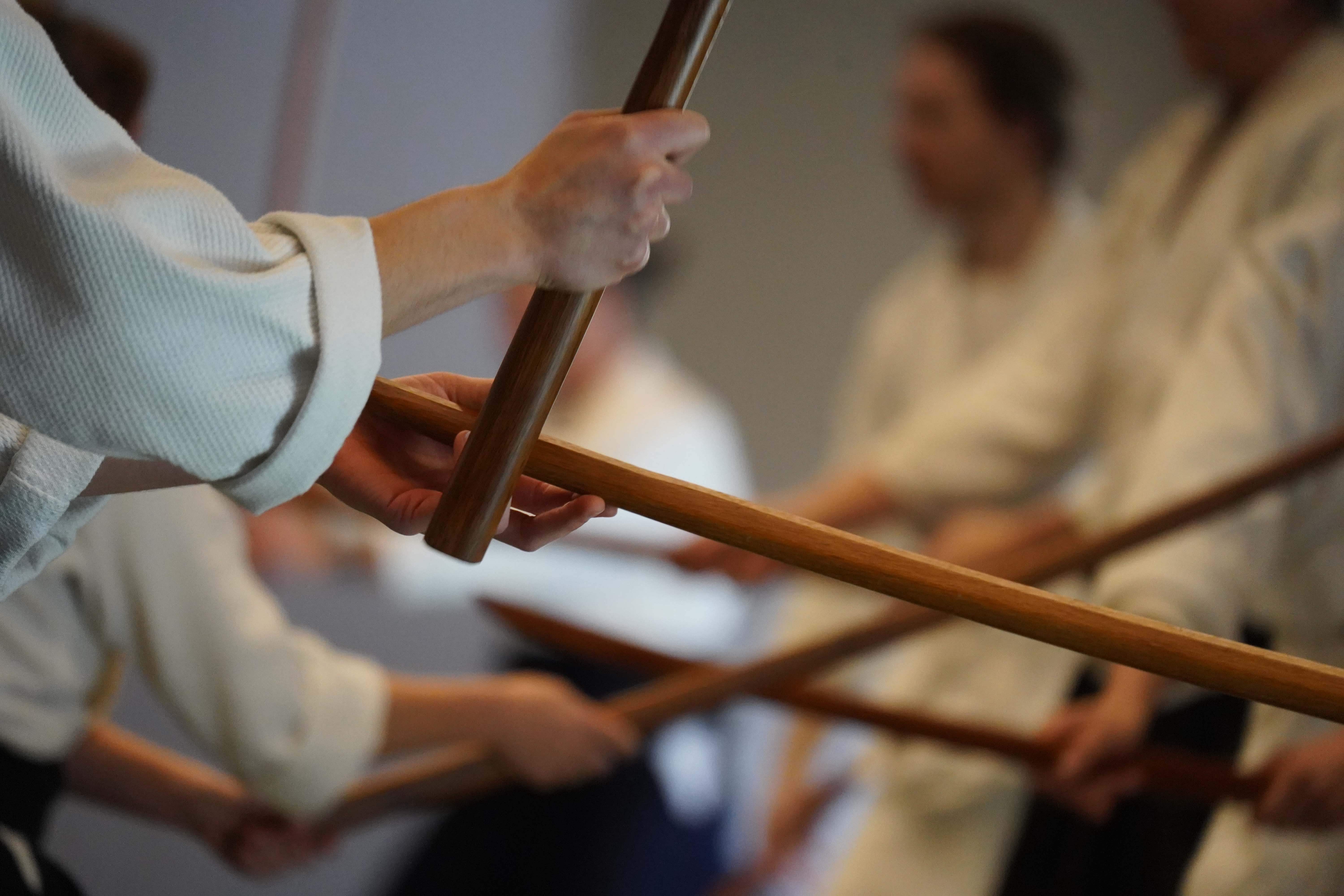
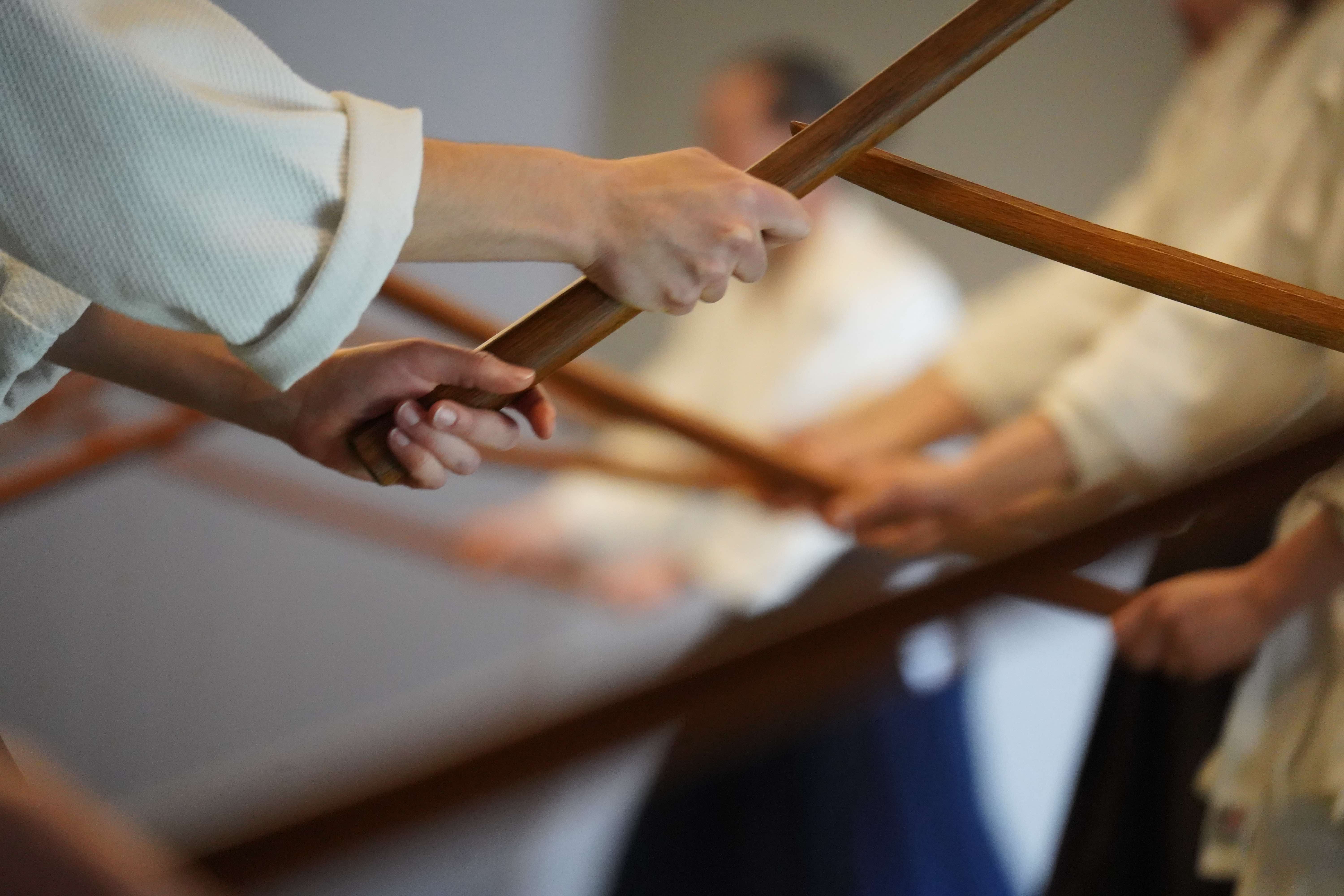
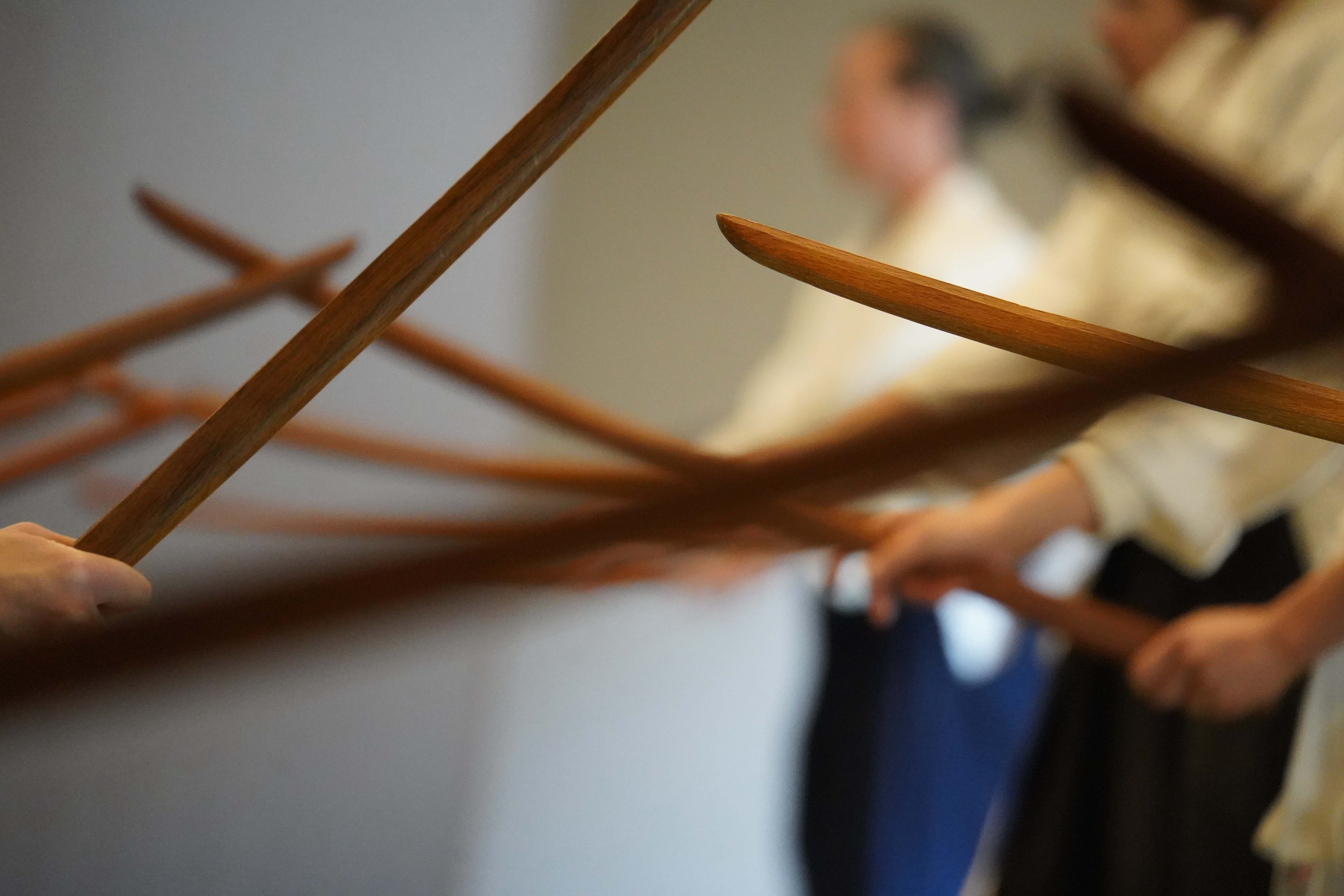
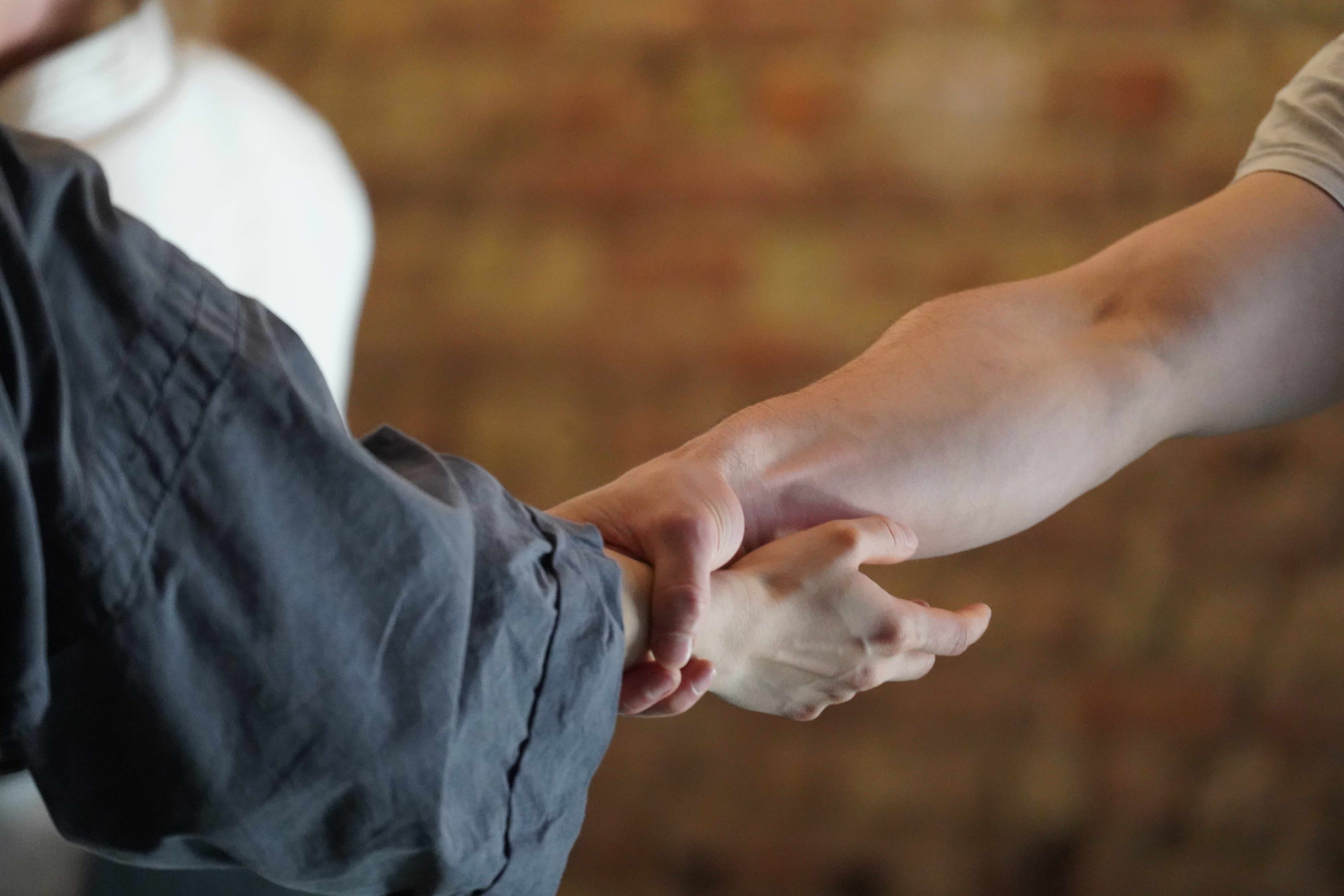
Some moments from the training with Master Gerhard Walter in March 2025. Photo by Aya Toraiwa, all rights reserved.